
ABOUT US
Overview
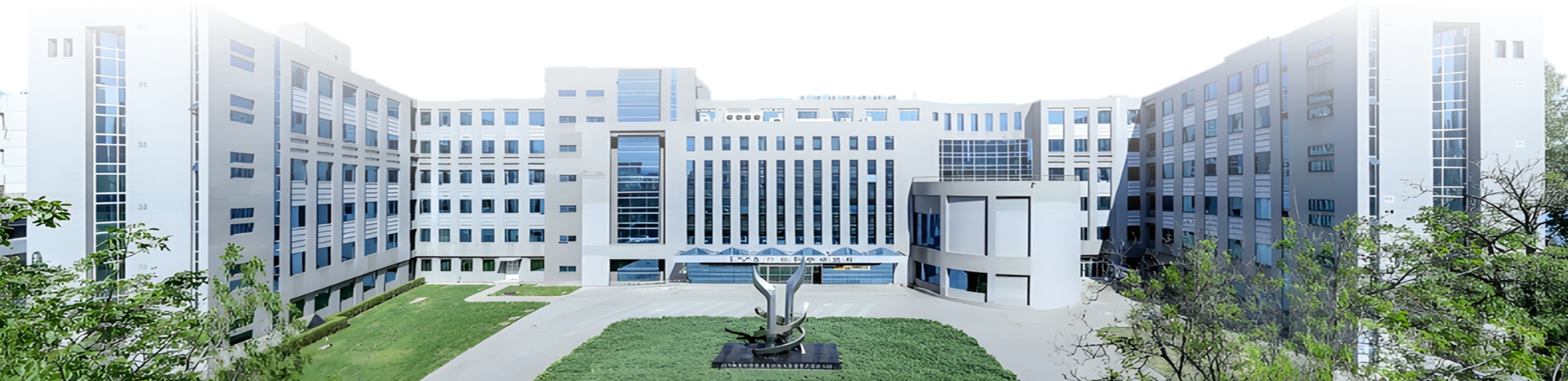
Founded in 2003 through a strategic restructuring of the former Institute of Crop Breeding and Cultivation, the Institute of Crop Germplasm Resources, and the crop-breeding division of the former Institute of Atomic Energy Utilization, ICS-CAAS is a national-level research entity specializing in crop science. Guided by the “Four Orientations,” the “Double First-Class” initiative, and the goal of achieving an overall leap in capability, ICS-CAAS focuses on wheat, maize, soybean, rice, and minor cereals, tracks global frontiers in crop science and technology, and responds to the needs of China’s modern agricultural development. With resource research as the foundation, gene discovery as the core, variety development as the objective, and agronomy/cultivation as the safeguard, ICS-CAAS carries out both basic and applied research to provide strong science-and-technology support for national food security and high-quality agricultural development. In recent years, through the National Agricultural Science and Technology Innovation Program, ICS-CAAS has formed a distinctive and advantageous disciplinary system and built competitive innovation teams and research platforms. It ranked first nationwide in the comprehensive assessment of research capacity among agricultural research institutions, playing a leading role in independent innovation in crop science.
Talent
Over more than six decades of development, ICS-CAAS has produced 11 academicians of the Chinese Academy of Sciences or the Chinese Academy of Engineering—Jin Shanbao, Chen Fengtong, Dai Song’en, Li Jingxiong, Xu Guaren, Bao Wenkui, Zhuang Qiaosheng, Dong Yuchen, Liu Xu, Wan Jianmin, and Qian Qian—together with a cohort of outstanding scientists including Deng Jingyang, Wang Lianzheng, and Zhai Huqu, who have made important contributions to crop-science progress and national food security. In 2024, ICS-CAAS had 1,863 on-post personnel, including 351 staff members, 503 contract employees, 103 postdoctoral fellows, and 906 graduate students. ICS-CAAS hosts 20 innovation teams and 52 innovation research groups, and has formed a cluster of nearly 80 leading talents, including 3 academicians, 54 selections into national-level talent programs, 6 Chief Scientists of national industry technology systems, and 45 awardees of CAAS-level talent programs. Awardees include 3 recipients of the Ho Leung Ho Lee Foundation Prize for Scientific and Technological Progress, 1 recipient of the China Agricultural Elite Award, and 3 recipients of the China Youth Science and Technology Award.
Structure
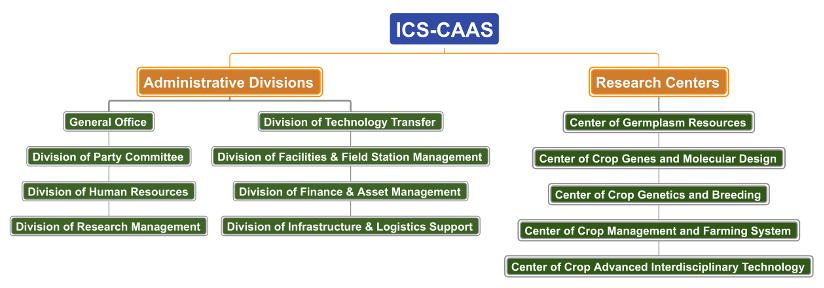
ICS-CAAS operates under a two-pillar governance and research framework. Administrative functions are centralized in the General Office and the Divisions of Party Committee, Human Resources, Research Management, Technology Transfer, Facilities & Field Station Management, Finance & Asset Management, and Infrastructure & Logistics Support. Research is organized through the Center of Germplasm Resources, Center of Crop Genes and Molecular Design, Center of Crop Genetics and Breeding, Center of Crop Management and Farming System, and Center of Crop Advanced Interdisciplinary Technology.
Research Platforms
ICS-CAAS operates 25 national-level, 15 provincial/ministerial-level, and 6 academy-level research platforms. Among these, the National Mega-Science Project on Crop Gene Resources and Genetic Improvement is the first mega-science project in China’s agricultural sector and provides a flagship platform integrating large-scale gene discovery, germplasm innovation, and breeding technologies.
Facilities
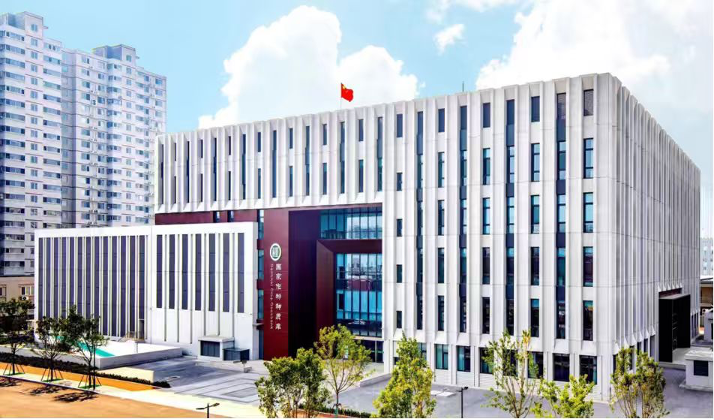
The new National Crop Genebank was completed in 2021 with a designed capacity of 1.5 million accessions and currently safeguards more than 500,000 accessions, ranking second worldwide. ICS-CAAS houses over 70 large instruments and pieces of equipment each valued above RMB 500,000; 12,000 m² of automated greenhouses; 28 growth chambers; 7,200 m² of drought-tolerance phenotyping facilities; 3,000 m² of disease- and pest-resistance screening facilities; and 11,000 m² of screenhouses. In major production zones, ICS-CAAS maintains 14 comprehensive experimental stations and 1,150 testing and demonstration sites for new varieties.
International Cooperation
ICS-CAAS attaches great importance to international collaboration and continues to expand its partnerships. Stable cooperation has been established with more than 60 countries—including Germany, the United Kingdom, France, Russia, Uruguay, Australia, Thailand, Myanmar, and Egypt—and with 10+ international organizations such as the International Maize and Wheat Improvement Center (CIMMYT), the International Rice Research Institute (IRRI), the International Atomic Energy Agency (IAEA), and Bioversity International. ICS-CAAS has built 13 international cooperation platforms, including the China–Australia Joint Center for Wheat Improvement and the China–Uruguay Soybean Research and Innovation Belt and Road Joint Laboratory; and has led 156 high-level conferences and training programs such as the 2nd International Wheat Congress, the 3rd International Agrobiodiversity Congress, and the Asia-Pacific Training Course on Crop Mutation Breeding, effectively promoting cross-regional academic exchange. ICS-CAAS has led 292 influential international cooperation projects. Among them, the Green Super Rice program funded by the Bill & Melinda Gates Foundation has delivered significant results, with rice varieties demonstrated and promoted in target countries across Asia and Africa, providing technological support for yield increases in Belt and Road countries. In addition, ICS-CAAS has united 25 institutions worldwide to prepare the international mega-science program “G2P: Elucidating Crop Gene Resources,” building a global collaborative research network on crop gene resources and contributing core strength to addressing global food security and sustainable development challenges.
Research Programs
ICS-CAAS actively organizes and participates in the formulation of national plans, implementation schemes, and guidelines for crop science and technology. Through careful planning and by uniting leading teams nationwide, ICS-CAAS undertakes major and key national projects in crop germplasm resources, molecular biology, genetics and breeding, and agronomy/physiology. Since 2003, ICS-CAAS has undertaken thousands of projects, including the 863 Program, the 973 Program, the Science and Technology Support Program, the National Key R&D Program of China, MARA agricultural industry technology systems, sectoral research special funds, the National Major S&T Project on GMOs, the National Natural Science Foundation of China, international cooperation projects, and projects commissioned by enterprises and local governments.
Scientific Achievements
Since 2003, ICS-CAAS—as the first-completing institution or with staff as first completers—has won 21 national-level S&T awards, including 1 Innovation Team Award, 5 First Prizes for Scientific and Technological Progress, and 15 Second Prizes. Over the same period, ICS-CAAS has identified a number of elite genes and bred 108 new wheat varieties, 64 maize varieties, 118 soybean varieties, 37 rice varieties, and 75 varieties of minor cereals; obtained 675 invention patents; and published 3,446 SCI-indexed papers, including 193 CAAS-selected top SCI papers. A relatively complete system for the conservation of crop germplasm resources has been established, with 580,000 accessions safely preserved.

Societies and Journals
Three academic societies are hosted by ICS-CAAS: the Crop Science Society of China (CSSC), the Genetic Resources Branch of the Chinese Society of Agronomy, and the Crop Biotechnology Branch of the Chinese Society of Agricultural Biotechnology. Journals for which ICS-CAAS serves as the primary sponsor include the bimonthly Journal of Plant Genetic Resources (co-sponsored with the Chinese Society of Agronomy) and the monthly China Seed Industry (co-sponsored with the China Seed Association). As a secondary sponsor with the Crop Science Society of China, ICS-CAAS co-publishes the monthly Acta Agronomica Sinica, the bimonthly The Crop Journal, and the bimonthly Crops.

Address:No.12 Zhongguancun South St.,Haidian
District, Beijing, P.R.China 100081
Tel: +86-10-82105813
Email:zkskyc@caas.cn
Fax:+86-10-82105819