
Gates Foundation International Cooperation Project: Helping West African Countries Establish the Rice Seed Industrial System
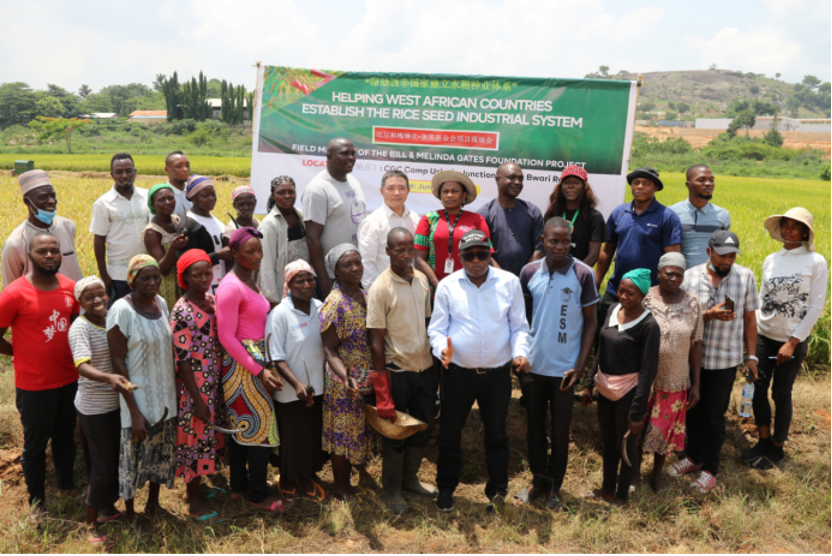
The largest China-led international agricultural science and technology poverty alleviation project, “Green Super Rice” for the Resource Poor of Africa and Asia, was launched in 2008. Using advanced breeding technologies, the project developed 78 new Green Super Rice (GSR) varieties featuring high yield, good quality, and multiple resistances, and promoted their adoption and application in target countries across Asia and Africa, generating sound socioeconomic benefits. However, compared with Asian countries, the results of GSR planting demonstrations in African countries have fallen far short of expectations. On the one hand, the number of GSR varieties officially released/approved in African countries is relatively small; on the other hand, Africa—especially West African countries—lacks an integrated rice breeding–seed multiplication–extension system. With support from the Gates Foundation, ICS-CAAS, together with the China National Rice Research Institute, the Agricultural Genomics Institute at Shenzhen, Chinese Academy of Agricultural Sciences, and the Shanghai Agrobiological Gene Center, as well as Nigeria Zhongdi Overseas Agriculture Development Co., Ltd., Mali Anhui Winall Seed Science and Technology Co., Ltd., and Nigeria’s National Cereals Research Institute, launched in 2021—in the target countries of Nigeria and Mali—the project “HELPING WEST AFRICAN COUNTRIES ESTABLISH THE RICE SEED INDUSTRIAL SYSTEM”, aiming to help these two countries develop more GSR varieties and establish a replicable technical system for rice breeding, seed production, and extension, thereby greatly enhancing rice production capacity in West Africa.
Over four years of implementation, the project has achieved a series of important results and progress. Using the hybrid rice variety MAYUN 1 and the inbred rice variety GAWAL R1 previously released/approved in the target countries, the project organized six high-yield cultivation demonstrations in the major rice ecologies of the two target countries, and conducted field visits and training courses on high-yield cultivation practices; in total, 800+ local extension personnel and farmers received training. In Nigeria and Mali, 30 new GSR combinations were trialed, and two water-saving and drought-tolerant hybrids and one high-yield hybrid were selected to enter Nigeria’s 2024 national regional trials, while three high-yield hybrids entered Mali’s national regional trials. Two new high-yield hybrid combinations, FENGYOU 360 and WINALL851, passed Mali’s national variety release/approval, and two drought-tolerant hybrids, FARO69 and FARO70, passed Nigeria’s release/approval process. In Mali, the project explored localized hybrid rice seed production techniques; the seed production yield of QUANYOU 521 remained stable at around 100 kg, and the conditions and technical measures for hybrid seed production in African countries were preliminarily summarized. In collaboration with Nigeria’s National Cereals Research Institute, the project carried out variety improvement for the locally grown varieties GAWAL R1 and FARO44, with progress made in molecular improvement for rice blast resistance, drought tolerance, and salinity tolerance, and 15 improved lines were developed with drought tolerance, rice blast resistance, and different combinations of stress-resistance traits. The project organized seed agents to establish a high-yield demonstration and seed marketing network for MAYUN 1 with six farms in Mali’s Selingue and San irrigation schemes. Through farmer forums to share and exchange GAWAL R1 planting experience, and by signing seed sales cooperation agreements with seed distributors in six representative regions in Nigeria, the GAWAL R1 variety has been promoted on 4,000+ hectares in Nigeria over the past two years. Project implementation has laid a solid foundation for new variety development, seed production and marketing, and the establishment of extension and scaling systems in Nigeria and Mali.

Address:No.12 Zhongguancun South St.,Haidian
District, Beijing, P.R.China 100081
Tel: +86-10-82105813
Email:zkskyc@caas.cn
Fax:+86-10-82105819