
1st Workshop on Plant Mutation Breeding Network for Asia Pacific(2019)
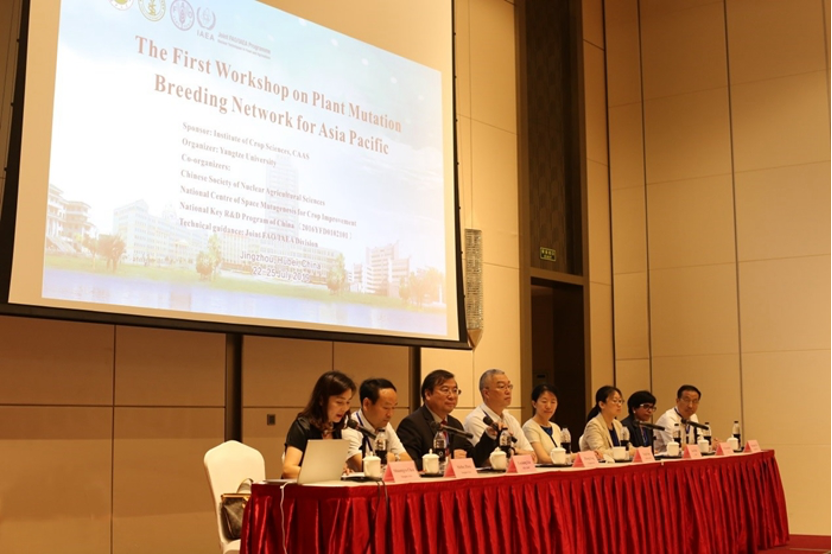
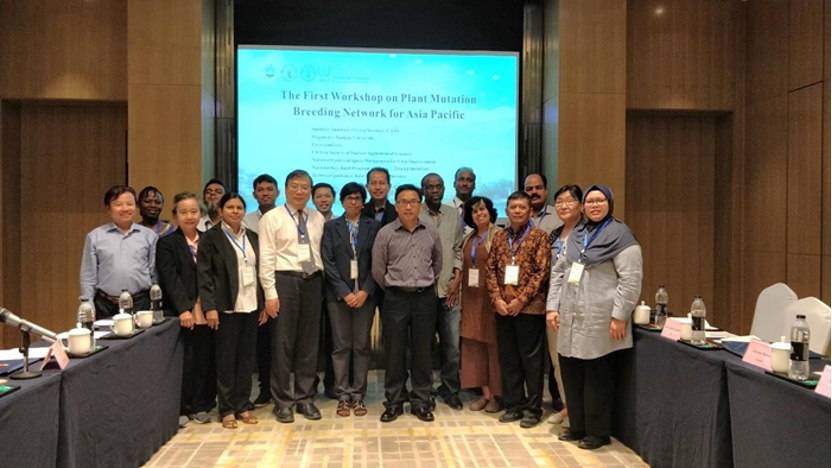
From July 22 to 25, 2019, the First Workshop on Plant Mutation Breeding Network for Asia Pacific (MBN)—hosted by ICS-CAAS and convened in Jingzhou, Hubei Province—was successfully held.
During the meeting, national representatives and observers engaged in extensive exchanges on network building; new techniques and methods in plant mutation breeding; integration of induced mutation with modern biotechnology; and challenges and countermeasures facing national and regional mutation-breeding programs. Participants presented the latest progress and successful cases from their countries/regions. Of the 3,246 mutant crop varieties developed worldwide using mutation techniques, more than 2,000 originate from Asia and the Pacific—over 60% of the global total—with China contributing the largest number. Many elite mutant varieties—such as Viet Nam’s rice Khang Dan, Thailand’s rice RD6 and RD15, India’s peanut TG26, Indonesia’s sorghum Pahat, Pakistan’s cotton NIAB-Karishma and mung bean NM-2016, Malaysia’s banana Novaria, and China’s wheat Luyuan 502—have been widely adopted, making important contributions to food security and farmers’ incomes across Member States and the region. Experts held in-depth discussions on germplasm exchange under the MBN framework, sharing of mutation-technology platforms, discovery and utilization of novel mutant genes, training of young professionals, joint project applications, and MBN operating mechanisms, and adopted the “Jingzhou Initiative.”
The workshop confirmed China, Indonesia, and India as members of the MBN Standing Steering Committee, with China serving as the inaugural chair country. It was decided that the MBN workshop will be held biennially, with the second session in 2021 in Malaysia.
It is noted that the “Bali Initiative,” proposed at the 2017 Indonesia Workshop on Plant Mutation Breeding, recommended establishing a regional network to enhance the efficiency of mutation breeding in Asia and the Pacific. Feasibility and necessity were further discussed during the International Symposium on Plant Mutation Breeding and Biotechnology (2018), followed by a preparatory expert meeting at IAEA Headquarters in Vienna in May 2019. The successful convening of this workshop will further promote technical exchange and cooperation on induced-mutation technologies in the food and agriculture sectors and advance sustainable agricultural development across the region.
The workshop received technical guidance from the FAO/IAEA Joint Division of Nuclear Techniques in Food and Agriculture, was hosted by ICS-CAAS and organized by Yangtze University, and was co-organized by the Chinese Society of Nuclear Agricultural Sciences, the National Center for Space-Induced Mutation Breeding of Crops, and the 13th Five-Year National Key R&D Program project on mutation breeding of major crops. More than 120 participants attended, including representatives from 13 member countries—Bangladesh, China, India, Indonesia, Lao PDR, Malaysia, Mongolia, Myanmar, Pakistan, the Philippines, Sri Lanka, Thailand, and Viet Nam—observer representatives from Australia, Cuba, and Senegal; officers from the Plant Breeding and Genetics Section of the FAO/IAEA Joint Division; and experts from the International Crops Research Institute for the Semi-Arid Tropics (ICRISAT), as well as Chinese experts and scholars engaged in plant mutation breeding.

Address:No.12 Zhongguancun South St.,Haidian
District, Beijing, P.R.China 100081
Tel: +86-10-82105813
Email:zkskyc@caas.cn
Fax:+86-10-82105819